Print Club News / 30th November 2025
Corona / crimson dawn / CV1
Experimental Print Club edition #33
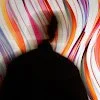
I’ve been working on this piece on and off since about June I think, in large part before starting work on my more recent Helios piece. I wanted to see if I could make an asymmetrical piece that has a really vigorous movement of line and ink coming from multiple centres of energy. As ever I like the idea of using the digital toolset to make work that couldn’t have been made in the pre-digital era; a spin painting more usually has only one centre of rotation, although as I write this now, I can appreciate that you could move and spin a canvas multiple times, so maybe that is more an aesthetic decision than a physical limitation.
Any student of art history will immediately notice that the work takes significant inspiration from the work of Sonia Delaunay and her husband and creative partner Robert Delaunay; along with some of the style and energy of the legendary British artist and printmaker Cyril Power whose best work was made between the wars.
I was lucky enough to have just enough time to visit the Musée d'Art Moderne de Paris this summer, in between changing trains on the way back from Southern Spain in early June. The galleries there display several of Delaunay’s huge canvases, each maybe 10ft high, the size alone is breathtaking and having only seen the works in reproduction previously, I was really taken by the ambition of the work and the energy it embodies.
Looking at both these new Print Club editions side by side on the bench here, it’s interesting to see the difference in the colouration and tonality between them. Corona seems far more punchy than the Helios piece, and I suspect that has something to do with the nature of the way they are drawn, the Corona study is purely digital and utilises pretty much everything I’ve learnt about working on system to capture energy in digital mark making, and spin it back out in a fairly gestural way, albeit a machine generated one.
For me, it’s been an interesting correlation between two very different ways of working, one far more haptic then the other. I’m hoping to push further into this territory in 2026, and allow myself to loosen up considerably more if I can.
I use the word ‘allow’ advisedly, as I think that idea of allowing yourself the time and permission to speak with your own voice, rather than hold back and edit it, lies at the heart of what I’ve been doing and not doing over recent years. Can it be possible to reach a place where the work is as loose and abstracted as, for instance, Sandra Blow’s extraordinary paint splattered canvases of the 1980’s. I’m not sure. Certainly the digital simultaneously puts a brake on that kind of kinetic action through it’s lack of immediacy of input, you can’t throw paint inside the system, but simultaneously allows you to edit actions in previously unimaginable ways. I wonder if I can in fact combine more kinetic real world mark making in the studio with digital techniques to create something more fluid and more dynamic than we’re seeing here. It’s something I’ll be thinking about more over the coming months.

Chuck Elliott
Links >
Sonia Delaunay at MAM, Paris
https://www.mam.paris.fr/en/expositions/exhibitions-sonia-delaunay
Cyril Power
https://en.wikipedia.org/wiki/Cyril_Power
Sandra Blow at Tate, St Ives
https://www.tate.org.uk/whats-on/tate-st-ives/sandra-blow
PS If your membership is currently paused, but you’d like this piece for your home, please do resubscribe and I’ll send it out to you.