Members of my Print Club receive three or four exclusive new editions in the post each year. Sign up today to receive the latest work…
About Helios delineated / night and day / EPC
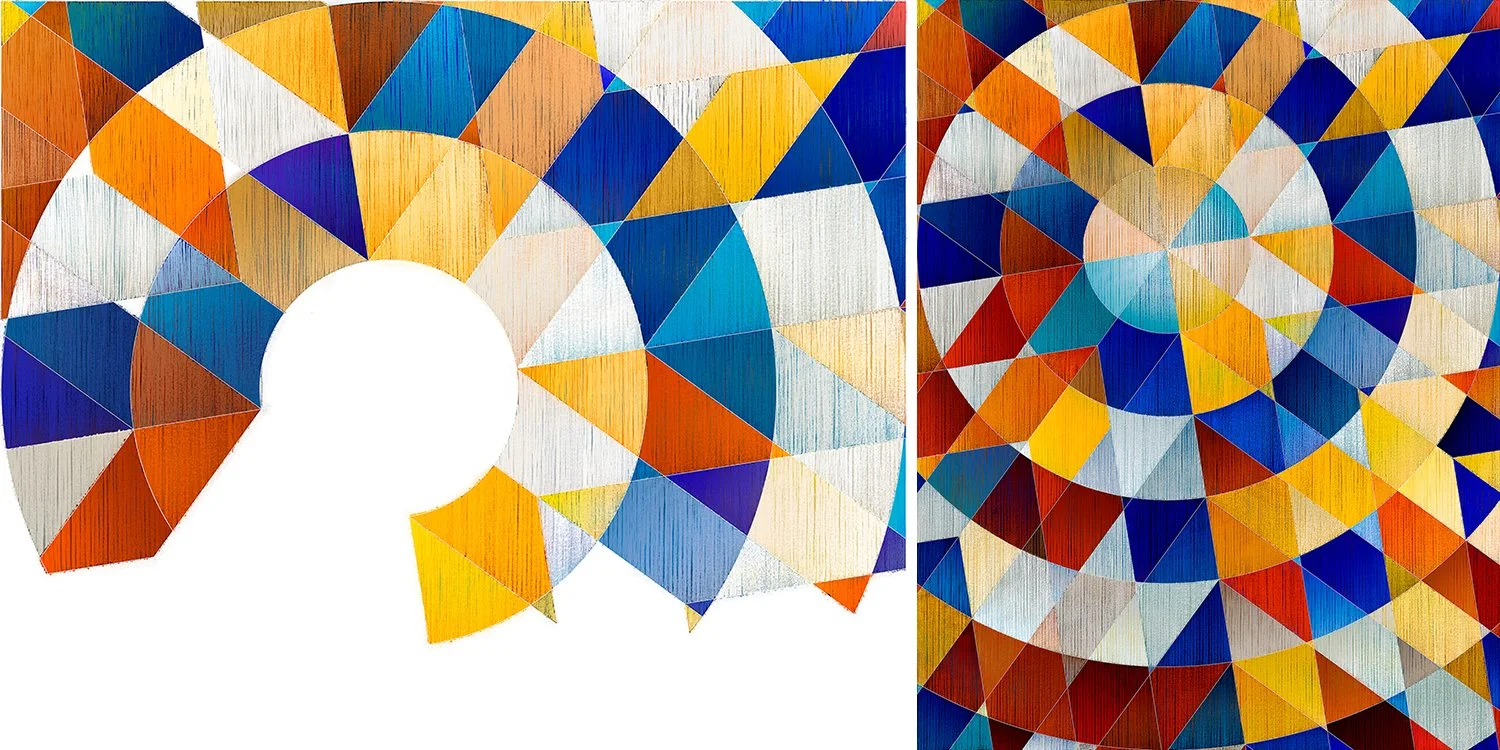
Helios delineated / night and day / EPC is the 34th work for my Experimental Print Club.
.
Helios delineated / night and day / EPC #34
.
10 colour pigment print on Hahnemühle 305gsm ultra smooth photo rag
Edition of 12, plus 2 APs
Printed in December 2025
.
Sheet size Xcm H x Xcm W
Image size Xcm H x Xcm W
In situ and in the studio
About the Print Club
If you’d like to receive three or four exclusive new editions in the post each year, alongside personal news and views from the studio, and invitations to shows and fairs, please do consider becoming a member of my Experimental Print Club. You can join or leave the club at any time, with absolutely no obligation to stay any longer than you want to.
New works are sent out somewhat sporadically throughout the year, often in line with the changing seasons. Each piece is unique, exclusive, and only available on the day it’s editioned, the size of the edition being determined by the number of members on the day.
I hope the club presents a more personal and intriguing way to connect with the studio, by creating a platform for collecting engaging new works for your home. The club is hosted online here, and I send out fairly regular blog posts and emails about the work too. I’d like to think that it’s an interesting proposition!
Membership is currently priced at £36 per month inc. UK delivery, or £42 for an international address.

From my blog / 3rd December 2025
I started drawing Helios at the fag end of September, so in essence it’s been a two month process to complete the drawing and edition the prints, much of that time spent hunched over a lightbox, 2H pencil in hand. Helios follows on from my Balla series, as an attempt to discover what it would feel like to slow down, and spend day after day quietly drawing a process led composition in graphite, pencil on paper. Does that equation of time spent for material gained seem worthwhile, does the balance seem right in the moment and after the event. I’m still processing that thought.
Each part of the geometry has been drawn three times, and those modular components have then been scanned, and composited digitally. Weeks and weeks of drawing the multi-layered parts. For the longest time I’ve been interested in the idea of making work that has taken a lot of labour to make; labour that can be both cyclical, meditative and perhaps in some way restorative too. Art as mindfulness perhaps. There are myriad problems with all of this, but nevertheless, I wanted to set about making a big drawing and see it through from the first mark to the final edit. I’m calling this edition the first state, a print term, as I now have a huge (20,000 pixel high) modular drawing that I can remix and re edit in any number of ways, almost certainly by overlaying new forms to dramatically add to the original composition in ways that I hope will emerge creatively as the drawing progresses day by day.
But for now, I wanted to actually edition this first state, colour balance it, punch up the overall tonality and sharpen the line work where it needs it. I actually drew the original components at half size, so that the process of enlarging the marks would also add distortion and ‘errors’ that would add life to the final piece, in the belief that the line would be more alive if it were also less perfect.
In the material world it wouldn’t be easily possible to overlay light crayon marks over deeply toned vignettes, or shift hue along the length of a single line, but the digital makes all this possible, so the final work becomes a kind of digital / analogue hybrid that speaks to both the handmade and the joy of the edit. I suspect most viewers won’t consciously notice that in places the colour shifts along individual lines, or that pops of colour show through from lines below lines; so hopefully the digital as it’s used here will exist in a kind of subconscious state that enhances the drawing without overtly revealing too much of the methodology in its making.
The genesis for this way of working comes from a multitude of strands that I’ve pulled together for this study. I think that may be the first time I’ve written that phrase, and realise that it comes from a relationship I have with a psychotherapist who will often tell me that he’s going to pull a few strands together for me. So be it. In this case the strands would include a beautiful woodcut block print by Chuck Close, one of his sublime portraits, that can use over 100 colours inked across more than 20 blocks, to create final prints of rare beauty. The printmaker Close works with claims to have taken five years to complete a single work, and when questioned by Close about changing elements of the print, rebuked him by saying that he had spent significantly more time with the artwork than Close had when he painted the original, and as such wasn’t going to be taking any advice on changing the print! I can’t think of many situations in which a person spends more time with an artwork than the original artist has, so it’s a lovely idea to my mind, that that could ever happen. Of course to some extent a piece framed for the wall may spend more time in the eye of its collector than it did in the eye of the artist, but that is at a different level of intensity from the study required to translate from one media to another, paint to print.
It won’t have escaped your attention that the piece also has a kind of textile or tapestry quality too. I’ve spent a lot of time looking at and enjoying the work of Kaffe Fassett, and many other makers like him. I’ve also spent time at the American Museum, just outside Bath, where they have a sublime collection of hand stitched quilts made by the earliest settlers as they moved across the mid West towards California. The history of that emigration is seen as highly controversial now, and rightly so, but the quilts remain as beautiful objects in their own right, individually and uniquely made by people to add warmth and colour to their lives and interiors. It’s a way of spending time that seems to me to be well worthwhile, or at least worthy of some further consideration and experiment.
I hope there’s also some sense of the woodblock, carved in a singular direction, and inked to give this lovely linear sense of movement through the use of the line as a key focus for the study. Hence my title, Helios delineated / night and day.
The final observation I would make here is simply that this is another piece in my ongoing series of sun and moon studies, that perhaps will resonate more as we reach the Winter solstice. I like the fundamental idea of capturing, on paper, some visual thoughts about the nature of the seasonal and annual cycles we live through each year, and the way that effects the time and energy we have in our lives as we travel.
I’m planning to work on with this drawing and make at least one more partner piece for it. No doubt there’ll be some images of that work at some point in 2026.
Associated works